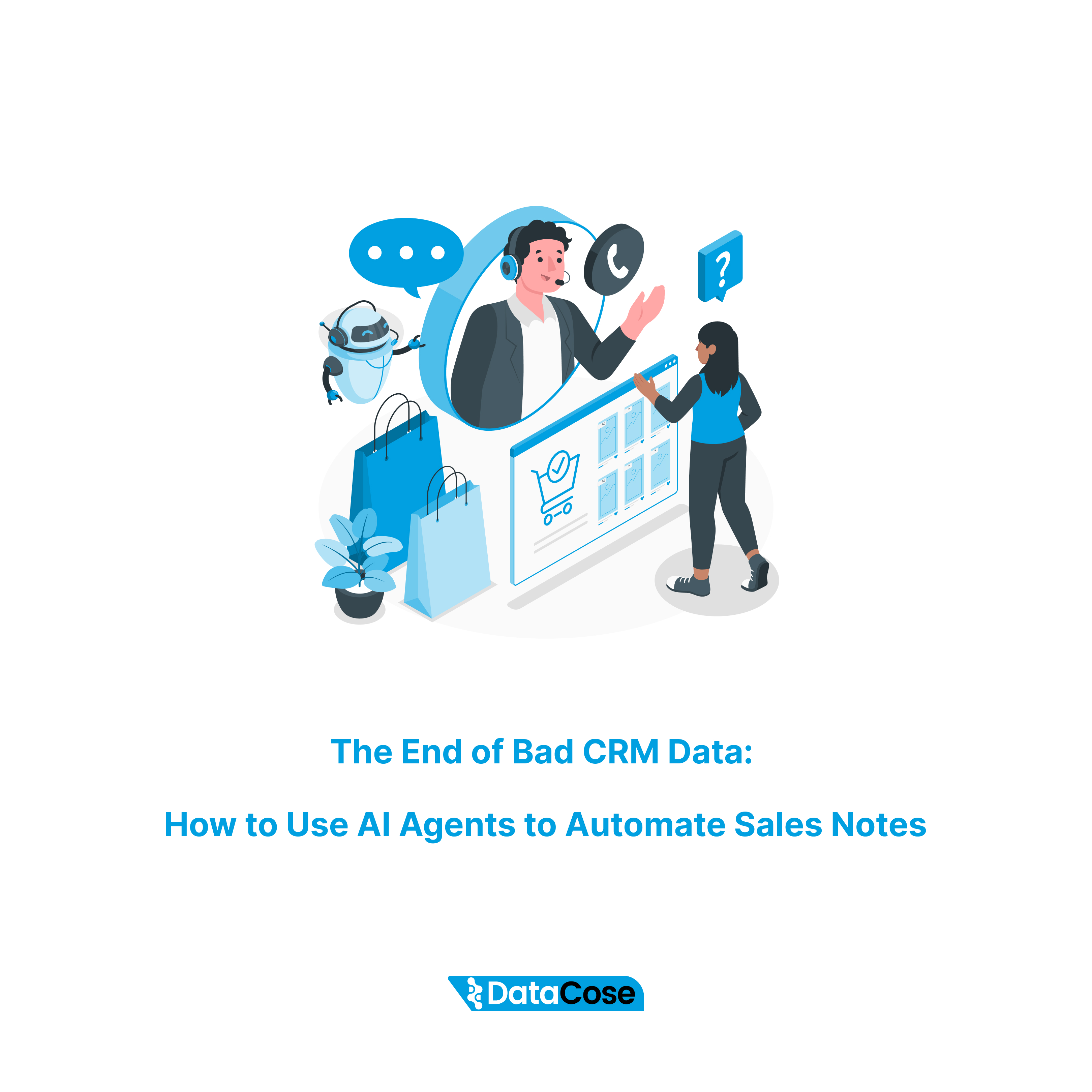
Your sales team hates updating the CRM. This leads to bad data, poor forecasting, and lost revenue. The solution is not to force them to type more.
The solution is to use "agentic AI" workflows. These are smart systems that do the work for you.
This guide shows you exactly how to build an AI system that turns sales calls into perfect data without the manual effort.
The Billion-Dollar Data Problem
Every business owner knows the pain. You look at your CRM (Customer Relationship Management) system to see how a deal is going. You see the last meeting date. But the notes section is empty. Or maybe it has three vague words.
You ask your sales leader what happened on the call. They have to rely on memory. The details are fuzzy. The action items are lost.
This is the "dirty data" problem.
Most companies accept this as a normal part of business. Salespeople want to sell, not type data. They finish a call and rush to send a follow-up email. Updating the CRM feels like a chore. It gets pushed to the end of the day. Then it gets pushed to the end of the week. Eventually, it never happens.
Read More: See how we apply this pattern matching in our guide on 4 essential business prompts for unbiased feedback.
But in 2025, this is a dangerous habit.
Data is the fuel for your business engine. If you want to use AI to predict revenue or train new hires, you need clean data. If your CRM is empty, your business is flying blind.
There is a new way to fix this. You do not need to hire an assistant for every salesperson. You need an Agentic AI Workflow.
What is an Agentic Workflow?
Most people use AI like a calculator. You type a question, and it gives an answer. That is useful, but it is passive.
An Agentic Workflow is different. Imagine AI acting like a smart team member. It does not just wait for you to talk to it. It takes action on its own. It can:
- Wait for a specific event (like a Zoom call ending).
- Ask you a question if it needs more info.
- Complete a task across different apps.
- Ask for approval before finishing the job.
This is the key to solving the CRM problem. You stop treating AI like a tool. You start treating it like a team member.
Read More: For a specific framework on decision making, check out our tutorial on the 1-3-1 AI prompt strategy.
Why Basic AI Sales Automation Isn't Enough
You might be thinking, "I already record my calls. Why do I need an agent?"
Recording calls is great. But a raw transcript is not data. It is just a wall of text. A one-hour sales call produces thousands of words. No CEO has time to read that.
Also, transcripts miss the most important part: The Human Insight.
A transcript records what was said. It does not record what was felt. It does not capture the salesperson’s gut feeling about the budget. It does not capture the skepticism in the prospect’s voice.
To get perfect CRM data, you need two things:
- The facts (from the transcript).
- The feelings (from the human).
An agentic workflow combines these two things automatically.,
Read More: To go deeper into maximizing output, read our 4-step guide to increasing AI ROI.
How to Build an Agentic AI Workflow for Sales Notes
Here is our step-by-step look at how you can build this system for your team. This process turns a painful chore into a one-minute task.
Step 1: The Trigger
The process starts automatically. You should not have to log in to a tool to start it.
- How it works: The system detects when a sales call ends on Zoom, Google Meet, or Teams.
- The Action: The AI grabs the transcript immediately.
Step 2: The Agent Asks for Insight
This is the magic step. The AI does not just summarize the text. It reaches out to the salesperson.
- How it works: The AI sends a direct message to the salesperson on Slack or Teams.
- The Message: It asks, "The call is over. What is your unique take on this deal? Any red flags or private notes?"
Step 3: The Human Input
The salesperson does not need to open a laptop or type a formal report.
- How it works: They can simply record a 30-second voice note on their phone or type a quick, messy sentence. "The buyer loves the product, but the CFO looks worried about price. We need to send a case study on ROI."
- Why this matters: It is low friction. It captures the critical context that never makes it into a formal report.
Step 4: The Synthesis
Now, the AI agent goes to work. It combines the two sources of information.
- Source A: The objective facts from the transcript (dates, features discussed, next steps).
- Source B: The subjective strategy from the human (gut feelings, hidden risks).
- The Output: The AI writes a perfectly formatted CRM note. It organizes the text into bullet points, action items, and strategic insights.
Step 5: The Approval
We never trust AI blindly. We always verify.
- How it works: The AI sends the draft back to the salesperson. "Here is the note for the CRM. Does this look right?"
- The Action: The human clicks "Approve" or makes a tiny edit.
- The Result: The note is automatically posted to the CRM (Salesforce, HubSpot, Pipedrive, etc.).
Read More: Learn how to apply this logic to risk management in our article on using AI to spot project flaws.
We Find 20+ Hours of Waste in Your Operations. Or We Pay You $500.
We are so confident in what this inspection reveals that we put our own cash on the line. If we cannot identify at least 20 wasted hours per week, we will send you $500. This is how sure we are that your business is leaking time and money right now.
Improving Sales Forecasting with Clean CRM Data
When you switch to this model, the benefits go far beyond saving time. Yes, your sales team will save 5 to 10 hours a week. But the real value is what happens to your business strategy.
1. Your Forecasts Become Real
Most sales forecasts are guesses. They are based on optimism. When you have detailed, structured data in your CRM, you can see the truth. You can spot which deals are actually stalling. You can see which objections keep coming up.
2. You Build a "Second Brain" for Sales
Imagine a new salesperson joins your team. Usually, it takes them months to learn how to sell your product. With this system, they can query your CRM. They can ask, "Show me how we handled price objections in the healthcare sector last year."
Because the data is clean and detailed, the AI can give them the answer.
Read More: Discover other leadership pitfalls in our piece on costly AI mistakes CEOs make.
3. You Can Automate the Next Step
Once the data is in the CRM, you can chain more automation to it.
- Did the note mention "Contract Review"? The system can automatically alert your legal team.
- Did the note mention "Pricing Concerns"? The system can draft an email for the CEO to step in and help.
Clean data triggers action.
Read More: See how top organizations are doing this in our blog on using AI to train stronger teams.
Why You Must Adopt Agentic AI Now
We are moving into an age where AI will run large parts of your operations. But AI models are only as good as the data you feed them.
If you feed an AI model empty CRM fields, it will hallucinate. It will give you bad advice.
If you feed it rich, context-heavy notes from your best salespeople, it becomes a superpower.
You have a choice to make. You can continue nagging your team to do administrative work they hate. Or, you can build a system that works for them.
This is about removing friction. When you remove the friction of data entry, you get more data. When you get more data, you make better decisions.
Getting Started with AI Sales Automation Tools
You do not need to be a coder to build this. Tools like Zapier, Make.com, and standard AI models (like GPT-5 or Claude) can be connected to build this workflow today.
Here is your checklist:
- Audit your current process: How long does it take your team to log a call?
- Check your tools: Do you have access to your call transcripts?
- Start small: Build a simple automation that summarizes the call first. Then, add the "agent" step where it asks for human input.
Summary
The old way of managing sales data is broken. It relies on tired humans doing robotic work.
The new way uses AI agents to handle the robotic work so humans can focus on strategy.
By implementing an agentic workflow, you ensure:
- Every call is logged.
- Every note includes human context.
- Your CRM becomes a competitive asset, not a digital junkyard.
Do not wait for your data to get better on its own. It won't. Build the system that makes it inevitable.
Find AI Initiatives in Your Business
Most business leaders know AI can drive efficiency and revenue, but they struggle to pinpoint exactly where to start. Stop guessing and get a concrete plan.
We built the AI Opportunity Detector to do the heavy lifting for you. Simply enter your website URL, and our team of AI agents will research your specific industry and business model in real-time.
That’s why we created the AI Opportunity Detector.
✔ 12 tailored, high-ROI AI opportunities
✔ An action plan specific to your industry
✔ Clear next steps your team can implement immediately
It's a free, 1-min tool that you drop your business website into. A team of AI Agents researches your business and industry to generate 12 tailored high-ROI AI initiatives.
[Find your top 12 AI opportunities with our free AI Opportunity Detector tool today.]